A small, specific ache appears near the end of a long run. You finish the workout, walk around for a while, and the pain fades. A few days later, the same spot starts hurting earlier in the run. Then it takes longer to settle down. Eventually, you feel it while walking to work, climbing the stairs, or sitting on the couch.
A stress fracture does not usually begin with one dramatic moment. There is no awkward landing, loud pop, or obvious accident to tell you that something has gone wrong. Instead, repetitive loading creates microscopic damage in the bone, and problems arise when that damage accumulates faster than the body can repair it.
For runners, the early stages are particularly easy to ignore. The pain may disappear after a run and return only when you train again. But continuing to load the area can allow a bone stress injury to progress from an early stress reaction to a more advanced injury or, in some cases, a complete fracture. The good news is that most bone stress injuries can be managed successfully when they are identified early and the right factors are addressed. The challenge is recognizing the pattern before the injury forces you to stop.
- What Is a Stress Fracture?
- Bone stress injury: a continuum
- Stress Fracture Symptoms: What Should Runners Look For?
- Common symptoms
- Stress fracture vs. shin splints vs. muscle soreness
- When should you see a doctor?
- What Causes Stress Fractures?
- 1. A sudden change in training load
- 2. Previous stress fracture
- 3. Low energy availability and RED-S
- 4. Nutrition and bone health
- 5. Sex and hormonal factors
- 6. Biomechanics
- What does the research actually support?
- Where Do Stress Fractures Occur in Runners?
- Why does location matter?
- Cortical vs. trabecular bone
- Diagnosis: How Is a Stress Fracture Confirmed?
- Why can an X-ray be normal?
- MRI
- MRI grading
- What About Blood Tests and Bone Density?
- Treatment
- Relative rest and load modification
- High-risk injuries
- Nutrition and RED-S
- Bone stimulators
- NSAIDs and pain medication
- How Long Does a Stress Fracture Take to Heal?
- Returning to Running
- Phase 1: Pain-free daily activity
- Phase 2: Strength and loading
- Phase 3: Run-walk intervals
- Phase 4: Build distance before intensity
- Use symptoms as feedback
- Preventing Another Stress Fracture
- 1. Increase training progressively
- 2. Build recovery into the plan
- 3. Do not under-fuel high mileage
- 4. Pay attention to menstrual health
- 5. Include strength training
- 6. Introduce new stimuli one at a time
- 7. Take focal bone pain seriously
- The Bottom Line
- Medical Disclaimer
- Sources
What Is a Stress Fracture?
A stress fracture is a bone injury caused by repeated loading rather than a single traumatic event. Bone is living tissue. It is constantly being remodeled: osteoclasts remove old or damaged bone, while osteoblasts build new tissue. Running places repeated mechanical stress on the skeleton, and under normal circumstances the bone adapts to that workload.
The problem appears when the amount of stress exceeds the bone’s ability to recover. That can happen after a sudden increase in mileage, a new training stimulus, insufficient recovery, inadequate energy intake, or a combination of several factors. It is not necessarily the result of one particularly hard workout.
A useful comparison is metal fatigue. A single bend may not damage a metal component enough to break it. Repeating the same stress thousands of times, however, can eventually produce microscopic cracks that grow until the material fails. Bone behaves in a similar way under repetitive loading.
Bone stress injury: a continuum
A stress fracture is better understood as part of a broader bone stress injury (BSI) continuum. At the earlier end is a stress reaction. The bone responds to repeated loading with changes such as bone marrow and periosteal edema, which can be detected on MRI. As the injury progresses, structural damage becomes more pronounced and a fracture line may eventually develop.
This means there is no requirement to wait for a visible fracture before taking symptoms seriously. The distinction is clinically important because an early bone stress injury may be easier to manage than a more advanced fracture. Continuing to run through progressively worsening focal bone pain is one of the ways a relatively manageable problem can become a much longer interruption to training.
Stress Fracture Symptoms: What Should Runners Look For?
The pattern of pain is often more useful than its intensity. One of the classic signs is focal pain. Instead of saying that the whole lower leg feels sore, a runner can often point to one specific area with a finger.
The symptoms may follow a recognizable progression:
- Pain appears toward the end of a run.
- It begins earlier as the injury develops.
- The discomfort lasts longer after exercise.
- Running becomes painful sooner.
- Walking or everyday activity starts to hurt.
- Pain may eventually occur at rest or during the night.
This progression is more concerning than a single episode of soreness after an unusually hard workout.
Common symptoms
A bone stress injury can cause:
- localized pain over a bone;
- tenderness when pressing directly over the affected area;
- pain that becomes worse with impact;
- pain that appears earlier during successive runs;
- swelling around the painful site;
- pain during walking;
- reduced ability to train normally;
- pain at rest or at night in more advanced injuries.
Not every runner will experience all of these symptoms. A single-leg hop may reproduce pain in some athletes, but it should not be treated as a home diagnostic test. A painful hop can raise suspicion for a bone injury, while a pain-free hop does not reliably rule one out.

Stress fracture vs. shin splints vs. muscle soreness
| Feature | Stress fracture | Shin splints (MTSS) | Muscle soreness/strain |
|---|---|---|---|
| Pain location | Usually very localized | Often spread along part of the inner shin | Usually within a muscle |
| Can you point to one spot? | Often yes | Usually more difficult | Usually less focal |
| Pain with impact | Common | Common | Variable |
| Pain progression | Often becomes earlier and more persistent | Usually related to running load | Usually improves with recovery |
| Tenderness over bone | Common | Can occur over a broader area | Usually muscular |
| Pain at rest | Possible, especially as injury progresses | Less typical | Less typical |
| Swelling | Possible | Usually limited | Possible |
These differences can help you decide whether an injury deserves further assessment, but symptoms alone cannot reliably distinguish every bone stress injury from other running injuries.
When should you see a doctor?
Persistent or worsening focal bone pain should not be something you simply try to run through.
Seek medical assessment if:
- the pain is becoming easier to provoke;
- it continues despite reducing training;
- normal walking becomes painful;
- there is visible swelling;
- you have significant tenderness directly over a bone;
- pain occurs at rest or wakes you at night;
- or the pain is located in the hip or groin.
Hip and groin pain deserves particular attention because a femoral neck stress injury can progress to a complete fracture and may have serious consequences if diagnosis is delayed.
What Causes Stress Fractures?
There is rarely one isolated cause. Bone stress injuries usually develop from an interaction between training load, recovery, nutrition, bone health, previous injury and individual characteristics. The relative importance of each factor varies from runner to runner. It is also important to separate established risk factors from theories that have become popular in running culture.
1. A sudden change in training load
Rapid changes in training are among the most practical factors to examine.
Examples include:
- a large jump in weekly mileage;
- adding speed sessions after a period of mostly easy running;
- introducing frequent hill workouts;
- increasing long-run distance and weekly mileage at the same time;
- returning to high mileage too quickly after a break;
- or combining several new training stresses in the same week.
The commonly cited 10% rule can be used as a conservative planning guideline, but there is no magic 10% threshold below which stress fractures cannot occur.
The more useful idea is progressive adaptation: give the bone enough time to adjust before adding another substantial increase in mechanical load.
2. Previous stress fracture
A previous stress fracture is one of the strongest documented risk factors. A systematic review and meta-analysis of runners found that a previous stress fracture was associated with almost a fivefold increase in the odds of another lower-extremity stress fracture. Female sex was also associated with increased risk, with a pooled odds ratio of 2.31.
A recurrent injury therefore deserves more than a simple period of rest. It is worth asking what allowed the first injury to develop in the first place.
3. Low energy availability and RED-S
Running places a substantial demand on the body, particularly when weekly mileage is high. If energy intake consistently falls short of what is required to support both training and normal physiological function, the consequences can extend beyond tiredness or poor performance.
Relative Energy Deficiency in Sport (RED-S) describes a state in which inadequate energy availability affects multiple body systems. Bone health is one of them.
In female runners, changes in menstrual regularity can be an important warning sign. Menstrual disturbances should not automatically be dismissed as a normal consequence of high mileage. The issue is not simply whether an athlete takes calcium or vitamin D. If low energy availability is part of the problem, taking supplements while continuing to under-fuel does not address the underlying cause.
4. Nutrition and bone health
Bone remodeling requires adequate energy and nutrients.
Factors worth considering include:
- overall calorie intake;
- calcium intake;
- vitamin D status;
- adequate protein and general nutritional quality;
- and sufficient energy availability during periods of heavy training.
A documented deficiency should be addressed appropriately rather than replaced with high-dose supplementation based on guesswork. For athletes with recurrent bone stress injuries, unusually low energy intake, menstrual disturbances, or other signs of impaired bone health, a more detailed medical and nutritional evaluation may be appropriate.
5. Sex and hormonal factors
Female runners have a higher observed risk of lower-extremity stress fractures than male runners. The reason is not simply biological sex itself; hormonal function, energy availability and bone health can all be involved.
The important practical point is that a stress fracture in a female athlete may warrant questions about menstrual history, nutrition and energy availability that would otherwise be missed.
6. Biomechanics
Running mechanics can affect how forces are distributed through the lower limb. Researchers have examined factors such as step rate, stride characteristics, foot structure, lower-limb alignment and other biomechanical variables.
However, this area is often oversimplified online. There is not enough evidence to say that one particular foot strike, running surface, cadence or shoe automatically causes stress fractures. Biomechanics may contribute to loading patterns, but it should be considered alongside training, recovery, bone health and nutrition rather than treated as the single explanation.
What does the research actually support?
This distinction matters. A systematic review and meta-analysis found that the two factors with the strongest evidence for lower-extremity stress fracture risk in runners were previous stress fracture history and female sex.
That does not mean other factors are irrelevant. It means the evidence is not equally strong for every factor commonly mentioned in running advice. A sensible prevention strategy therefore starts with the areas that can be monitored and modified: training progression, recovery, adequate energy availability, nutrition and previous injury history.
Where Do Stress Fractures Occur in Runners?
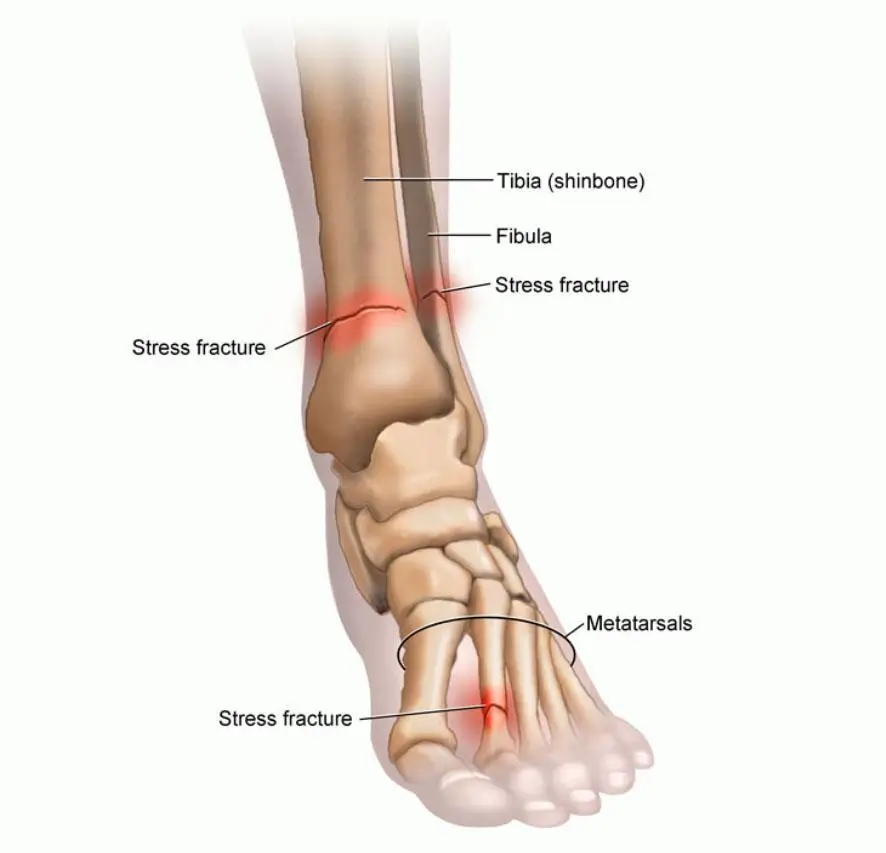
Stress fractures can develop in many bones, but the lower leg and foot are particularly important in runners.
Common locations include the:
- tibia;
- metatarsals;
- fibula;
- femur;
- navicular;
- pelvis and sacrum.
The location matters because not all stress fractures have the same healing potential. Clinicians commonly classify them as low-risk or high-risk injuries according to their likelihood of delayed healing, nonunion or progression to a complete fracture.
| Low-risk locations | High-risk locations |
|---|---|
| Posteromedial tibial shaft | Anterior tibial cortex |
| Fibula | Tarsal navicular |
| 2nd–4th metatarsal shafts | Femoral neck, particularly the tension side |
| Pubic bone | Medial malleolus |
| Sacrum | Talus |
| Ribs | Proximal 5th metatarsal |
| Some femoral shaft injuries | Great toe sesamoids |
The exact classification can vary according to the precise location and fracture pattern, particularly in the foot. For example, not every fifth metatarsal or metatarsal stress injury carries the same risk.
Why does location matter?
Blood supply, bone structure and mechanical loading all influence how an injury behaves. High-risk sites have a greater chance of delayed union, nonunion or progression. That is why a suspected navicular, anterior tibial or femoral neck injury should be assessed more cautiously than an uncomplicated low-risk metatarsal injury.
Location also affects recovery time. A 2023 systematic review and meta-analysis of almost 3,000 bone stress injuries found the longest pooled return-to-sport times for the tarsal navicular (127 days) and femoral neck (107 days). By comparison, the pooled figures were about 44 days for the posteromedial tibial shaft and 56 days for the fibula. These are averages from groups of athletes, not deadlines for an individual runner.
Cortical vs. trabecular bone
The type of bone involved also appears to matter. Cortical bone forms the dense outer structure of many long bones, while trabecular bone has a more porous, lattice-like structure.
Research has found that bone stress injuries at trabecular-rich sites such as the pelvis and femoral neck can take substantially longer to return to sport than injuries involving cortical-rich locations such as the tibia or metatarsals. That is another reason why the location of the pain is not a minor detail.
Diagnosis: How Is a Stress Fracture Confirmed?
Diagnosis starts with the story. A sports medicine physician or other qualified clinician will usually want to know:
- what changed in your training;
- when the pain started;
- where exactly it hurts;
- whether the pain is becoming easier to provoke;
- whether walking is painful;
- whether there is swelling;
- whether you have had a stress fracture before;
- and whether there are nutritional, hormonal or other health factors that could affect bone.
The physical examination may include palpation, functional testing and assessment of the surrounding muscles and joints. But an examination cannot always tell how advanced the bone injury is.
Why can an X-ray be normal?
One of the frustrating features of stress fractures is that early X-rays may look completely normal. Conventional radiographs can fail to show an acute stress injury during the first several weeks. A normal X-ray therefore does not automatically rule out a bone stress injury when the clinical picture remains suspicious.
MRI
MRI is the preferred imaging method for identifying bone stress injuries when imaging is required.
It can show bone marrow edema and periosteal changes before a fracture becomes visible on an X-ray. MRI also provides information about the severity of the injury, which can help with prognosis and rehabilitation planning.
MRI grading
One commonly used system is the Fredericson classification, originally developed for tibial stress injuries. In simplified terms, the grading progresses from periosteal changes to increasing bone marrow involvement and, at the most advanced end, cortical abnormalities. The exact interpretation belongs to the radiologist or clinician reviewing the images, but the general principle is straightforward: more extensive MRI abnormalities tend to be associated with a longer return to sport.
A systematic review and meta-analysis of 560 bone stress injuries found a clear relationship between higher MRI grades and longer return-to-sport times. Mean return times increased from about 42 days for grade 1 injuries to about 99 days for grade 4 injuries. MRI therefore provides information that pain intensity alone cannot.
What About Blood Tests and Bone Density?
Imaging is only part of the evaluation. For a first, straightforward low-risk injury, extensive laboratory testing may not always be necessary. But recurrent stress fractures, multiple bone stress injuries, unusually severe injuries, or signs of low energy availability can justify a broader investigation.
Depending on the clinical situation, a physician may consider evaluating:
- vitamin D status;
- calcium and other relevant nutritional markers;
- blood count and iron status when appropriate;
- thyroid or hormonal factors when indicated;
- nutritional intake and energy availability;
- menstrual history in female athletes;
- and bone mineral density.
A DXA scan may be considered when there is concern about low bone mineral density or recurrent bone stress injury. The purpose is not to order every possible test after every painful run. It is to identify an underlying problem when the injury pattern suggests that something beyond training load may be involved.
Treatment
Treatment depends heavily on the location and severity of the injury. There is no single stress-fracture protocol that works for every bone.
Relative rest and load modification
For many low-risk injuries, the main goal is to remove the mechanical load that is causing symptoms while maintaining as much fitness as the injury allows.
Depending on the location and severity, this may include:
- stopping running temporarily;
- cycling if it is completely pain-free;
- swimming;
- pool running;
- upper-body conditioning;
- or other low-impact activities.
The key word is pain-free. Cross-training is useful only if it does not continue to irritate the injured bone.
High-risk injuries
High-risk locations require greater caution. Treatment may include:
- a walking boot;
- crutches;
- protected weight bearing;
- a period of non-weight bearing;
- repeat imaging or clinical follow-up;
- and, in some cases, surgery.
This is particularly relevant to injuries involving the femoral neck, anterior tibia, navicular, talus, proximal fifth metatarsal and other recognized high-risk sites. Trying to manage a suspected high-risk stress fracture independently is not a good strategy.
Nutrition and RED-S
If inadequate energy availability, vitamin D deficiency, low calcium intake or another nutritional issue is contributing to the injury, rest alone does not solve the whole problem. The goal is to restore the conditions required for normal bone remodeling. For athletes with suspected RED-S, management may involve a sports medicine physician, sports dietitian and, where appropriate, an endocrinologist or gynecologist.
Bone stimulators
Electromagnetic stimulation, low-intensity pulsed ultrasound and other bone-stimulation technologies have been studied as possible ways to support healing. The evidence for their routine use in stress fractures remains limited and inconsistent. They should not be presented as a reliable shortcut that allows an athlete to return to running sooner. Evidence reviews continue to describe uncertainty around these adjunctive treatments.
NSAIDs and pain medication
Pain relief can make symptoms easier to tolerate, but that does not mean the bone has recovered. There are also concerns about prolonged NSAID use and its potential effects on bone healing and remodeling. For that reason, medication should not be used to mask symptoms so that training can continue. If a runner needs pain medication simply to complete a workout, the more important question is why the workout is still being attempted.
How Long Does a Stress Fracture Take to Heal?
There is no universal recovery time. Healing depends on:
- the affected bone;
- the exact location;
- whether it is low-risk or high-risk;
- MRI grade;
- severity;
- whether the athlete can protect the area adequately;
- nutritional and hormonal health;
- previous injury history;
- and the response to rehabilitation.
As a rough orientation, some low-risk injuries may allow a gradual return to running after roughly 6–8 weeks, while high-risk or trabecular-rich injuries can take considerably longer.
The research makes the variation clear. Higher MRI grades are associated with longer return-to-sport times, while anatomical location also has a strong effect on prognosis. So a statement such as “stress fractures always take six weeks” is misleading. Some runners return sooner. Others need several months.

Returning to Running
Getting back to running should be treated as a progression in loading capacity, not as a date on the calendar. Before impact training resumes, clinicians may look for several signs that the bone is ready:
- pain-free normal walking;
- resolution or substantial improvement of focal bone tenderness;
- adequate strength;
- successful functional or loading tests;
- appropriate healing on imaging when required, particularly for high-risk injuries;
- and correction of important contributing factors.
Phase 1: Pain-free daily activity
Normal walking and everyday activity should be comfortable. If walking still reproduces the original bone pain, running is usually premature.
Phase 2: Strength and loading
The next step is rebuilding lower-body strength and tolerance to loading. Exercises should be introduced progressively and should not reproduce the original focal pain.
Phase 3: Run-walk intervals
Running is often reintroduced through short run-walk sessions. For example, a runner might begin with brief running intervals separated by walking rather than immediately returning to continuous easy mileage. The exact starting point depends on the injury and the athlete’s clinical assessment.
Phase 4: Build distance before intensity
Once short running sessions are tolerated, distance can gradually increase. It generally makes more sense to restore basic running volume before bringing back demanding intervals, hills or hard tempo work. Speed creates another substantial loading stimulus, so there is little benefit in trying to prove fitness during the first weeks of a comeback.
Use symptoms as feedback
The most useful rule is simple: Do not progress because the calendar says you should. Progress because your body is tolerating the current load. If the original focal pain returns during a session or becomes worse afterward, that is a reason to reduce the load and reassess. A 2024 review of return-to-running criteria after tibial bone stress injuries highlighted pain-free walking, resolution of bony tenderness, strength and functional testing, consideration of radiological healing for high-risk injuries, and correction of contributing factors before running is resumed. The evidence for exact return-to-running schedules is still limited, so individualization matters.
Preventing Another Stress Fracture
Prevention is less about finding one perfect shoe or running technique and more about keeping the overall training system sustainable.
1. Increase training progressively
Avoid making several major changes at once. If weekly mileage is increasing, keep other variables relatively stable. If you are adding hills or speed work, avoid simultaneously making a large jump in volume. The commonly used 10% guideline can provide a conservative framework, but it is not a guarantee against injury.
2. Build recovery into the plan
Bone adapts between training sessions, not only during them. Regular easier periods can help manage accumulated training stress. Some runners use a lower-volume week every three or four weeks, although the ideal pattern depends on training age, volume and individual recovery.
3. Do not under-fuel high mileage
A large training load requires enough energy to support both performance and normal physiological function. Persistent under-fueling can affect recovery and bone health, particularly when combined with other risk factors.
4. Pay attention to menstrual health
For female runners, a change in menstrual regularity can be an important health signal. It should not simply be accepted as an unavoidable consequence of high mileage.
5. Include strength training
Resistance training can improve muscular strength and help the body tolerate mechanical loading. It is not a replacement for sensible running progression, but it can be a useful part of a broader injury-prevention strategy.
6. Introduce new stimuli one at a time
Hills, intervals, trail running, longer long runs and increased weekly mileage all change the mechanical demands placed on the body. Stacking several of these changes together makes it much harder to know whether the current workload is appropriate.
7. Take focal bone pain seriously
This may be the simplest rule of all. If the same small area starts hurting during repeated runs, especially if the pain appears earlier each time, do not wait until you are limping. Reducing the load early and getting the injury assessed can be far easier than dealing with an established fracture several weeks later.
The Bottom Line
A stress fracture is not ordinary post-run soreness. It is part of a bone stress injury process in which repetitive loading has exceeded the bone’s ability to remodel and recover. The warning signs can be surprisingly quiet at first: a small ache late in a run, followed by pain that arrives earlier, lasts longer and eventually appears during walking.
The most useful clues are the location and progression of the pain. A runner who can point to one small area of bone that repeatedly hurts under impact should pay attention, particularly when the symptoms are becoming easier to provoke. Training progression, recovery and adequate energy availability are among the most practical factors to manage. Previous stress fracture history is an important risk marker, while female runners may have additional considerations related to energy availability, menstrual function and bone health.
At the same time, not every factor commonly blamed for stress fractures has equally strong scientific support. Running surface, foot strike, cadence and other biomechanical characteristics may influence loading, but they should not automatically be treated as proven causes. Location matters enormously. Injuries involving the femoral neck, anterior tibia, navicular and certain parts of the foot carry greater risks and often require more careful investigation and management.
MRI can identify bone stress changes that are invisible on early X-rays, and MRI severity and injury location can both help estimate how long recovery may take. The safest return to running is not the fastest one on paper. It is the progression that restores the bone’s ability to tolerate load without bringing the original pain back. If you are rebuilding weekly mileage after an injury, a running calculator can also help you plan changes in volume and pace more systematically rather than making large jumps from one week to the next.
Medical Disclaimer
This article is provided for informational and educational purposes only. It is not a medical diagnosis, treatment plan or substitute for individualized medical advice.
The information presented here cannot account for an individual runner’s anatomy, medical history, previous injuries, training background, nutritional status or clinical findings. It should not be used to diagnose a stress fracture or create an independent rehabilitation program. If you develop persistent or progressively worsening focal bone pain, especially pain associated with swelling, pain during walking, pain at rest or pain that wakes you at night, seek assessment from a qualified healthcare professional.
Particular caution is warranted when pain occurs around the hip or groin, navicular region, anterior tibia or other high-risk locations. A sports medicine physician, orthopedic specialist or appropriately qualified physiotherapist can determine whether further examination or imaging is required.
The medical sources below are provided so readers can review the underlying research. Their inclusion does not constitute an endorsement of a particular treatment for an individual patient.
Sources
- Mayo Clinic — Stress fractures: Symptoms & causes
- PubMed — Stress fractures in runners (PMID 20610029)
- PubMed — Risk factors associated with lower extremity stress fractures in runners: systematic review and meta-analysis
- PubMed — Stress fractures of the pelvis and legs in athletes: a review
- PubMed — High-Risk Stress Fractures: Diagnosis and Management
- PubMed — Foot and Ankle Stress Fractures in Athletes
- PubMed — Stress fractures of the foot: current evidence on management
- PubMed — Stress fractures of the femoral neck in runners: a review
- PubMed — Does MRI Grading Correlate With Return to Sports After Bone Stress Injuries?
- PubMed — Return to sport following low-risk and high-risk bone stress injuries: systematic review and meta-analysis
- PubMed — Criteria and Guidelines for Returning to Running Following a Tibial Bone Stress Injury
- PubMed — International Delphi consensus on bone stress injuries in athletes
- American Journal of Roentgenology — Validation of the Fredericson MRI Classification System for Tibial Stress Injuries
- American Journal of Sports Medicine — MRI Grading and Return to Sports Meta-analysis
- Radiopaedia — MRI grading systems for bone stress injuries