

You’re six miles into a ten-mile tempo run. The pace feels controlled — hard, but manageable. Then somewhere around mile eight, the wheels quietly come off. Your legs fill up, your breathing turns ragged, and the pace you were holding thirty seconds ago now feels like a sprint. You didn’t bonk. You didn’t cramp. You hit your lactate threshold — and blew past it.
Understanding exactly what happened in your body at that moment, and how to push that wall further back, is one of the highest-leverage things a serious runner can do. More than VO2max. More than running economy. More than mileage. The research is unambiguous on this point, and the practical implications are enormous.
- What is Lactate Threshold? The physiology behind the burn
- It’s not what most runners think
- LT1 vs LT2: Why the distinction is more important than most coaches admit
- Two thresholds, two different training targets
- Why Lactate Threshold predicts race performance better than VO2max alone
- The number that actually wins races
- How to find your Lactate Threshold pace
- Lab testing, field testing, and what actually works
- The most effective training methods to raise your Lactate Threshold
- Not all hard workouts are threshold workouts
- Sample 8-week threshold training progression
- Common mistakes runners make with Threshold training
- Why your tempo runs might not be working
- How Lactate Threshold changes over time: What training actually does to your body
- The adaptations that push the wall back
- Frequently Asked Questions
- Conclusion
- Sources
What is Lactate Threshold? The physiology behind the burn
It’s not what most runners think
For decades, lactic acid had a reputation as the villain of hard efforts — the substance your muscles produced as a punishment for going too fast. That picture is wrong, and it matters that you understand why.
Lactate is not a waste product. It’s a fuel. When your muscles break down glucose faster than they can process it through aerobic pathways, they produce lactate as a byproduct. But here’s what George Brooks’s landmark lactate shuttle research established clearly: lactate is actively shuttled between cells and used as an energy source by the heart, slow-twitch muscle fibers, and the liver (Brooks, 2018, Cell Metabolism). Your body is constantly producing and clearing lactate, even at rest.
The threshold isn’t where lactate appears. It’s where production begins to outrun clearance.
At easy paces, your aerobic system clears lactate almost as fast as it’s made. Blood lactate levels stay low — typically 1–2 mmol/L. As pace increases, production accelerates. At some point, clearance can no longer keep up, and lactate begins accumulating in the blood. That inflection point is your lactate threshold.
The acidosis you feel — the burning sensation in your legs — comes not from lactate itself, but from the hydrogen ions released alongside it. This distinction matters because it reframes the entire training project: you’re not trying to “avoid” lactate, you’re training your body to clear it faster.
LT1 vs LT2: Why the distinction is more important than most coaches admit
Two thresholds, two different training targets
Most runners talk about “the lactate threshold” as if it’s a single point. The reality is more nuanced — and more useful. Exercise physiologists identify two distinct thresholds, and confusing them is one of the most common reasons threshold training fails to deliver results.
LT1 — the aerobic threshold: This is the intensity where lactate begins to rise above baseline levels. Below LT1, your body is almost entirely aerobic. Blood lactate is typically 1.5–2.5 mmol/L. This corresponds roughly to a “comfortably conversational” effort — the top of Zone 2. Elite marathon runners race very close to LT1 for 26.2 miles.
LT2 — the anaerobic threshold (MLSS): This is the point of maximal lactate steady state — the highest intensity at which your body can still clear lactate fast enough to maintain equilibrium. Blood lactate is typically around 4 mmol/L. Above LT2, lactate accumulates exponentially and performance degrades within minutes. This is the true tempo pace zone — the effort you can sustain for roughly 45–60 minutes in a race.
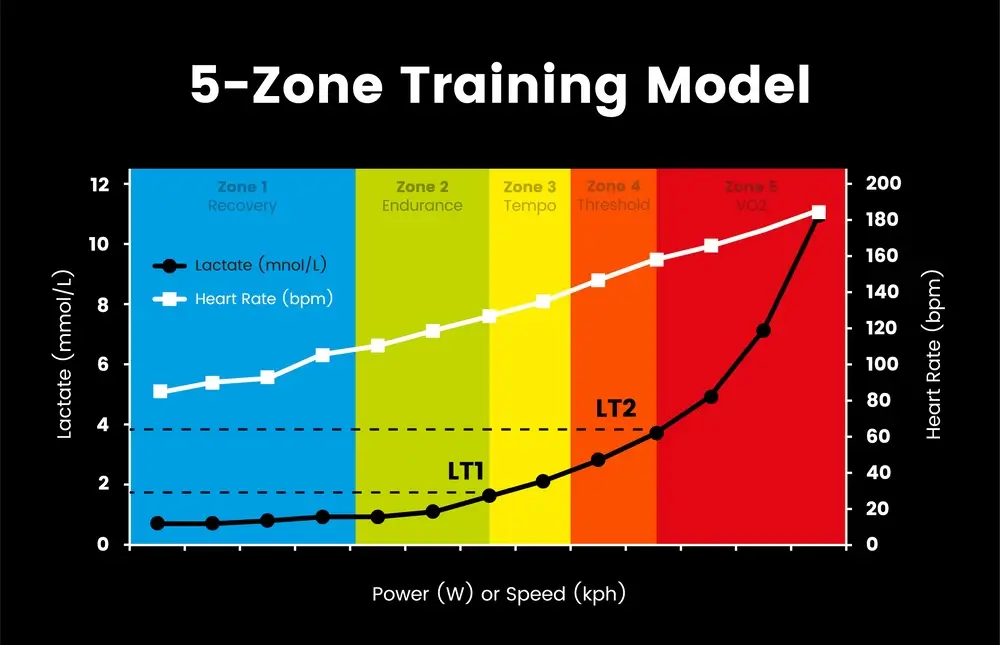
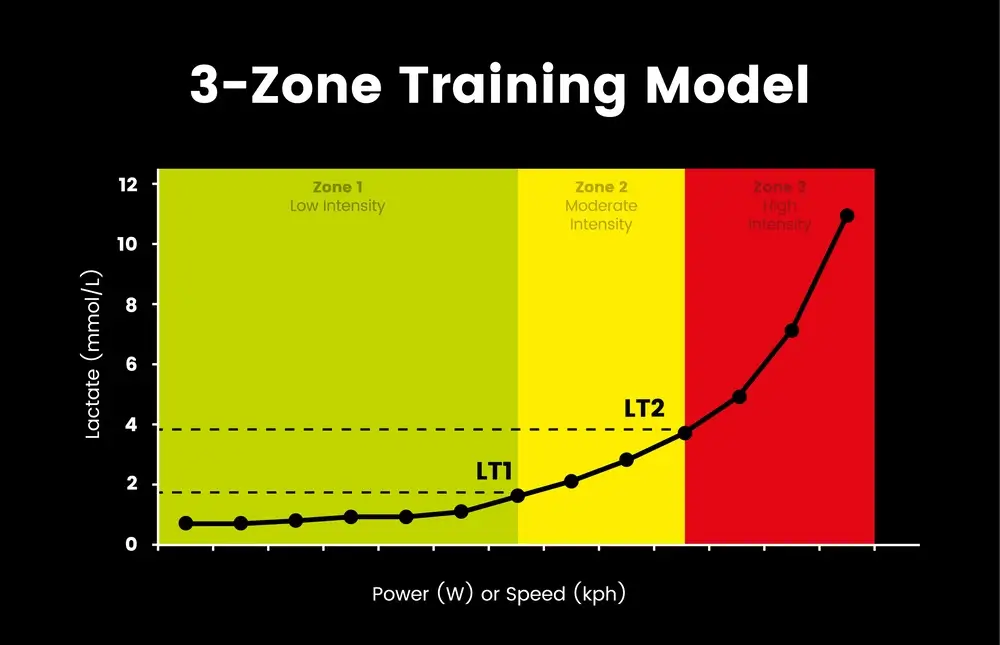
The Faude, Kindermann & Meyer review (2009, Sports Medicine) catalogued over 25 different definitions and measurement methods for lactate threshold. Their conclusion: LT1 and LT2 serve distinct physiological roles and require different training stimuli. Most runners train in the gray zone between them — hard enough to feel like work, but not precise enough to actually stress the right system.
| LT1 (Aerobic Threshold) | LT2 (Anaerobic Threshold) | |
|---|---|---|
| Blood lactate | ~1.5–2.5 mmol/L | ~3.5–5 mmol/L |
| Perceived effort | Conversational, controlled | Comfortably hard, focused |
| Heart rate | ~75–82% max HR | ~85–92% max HR |
| How long you can hold it | Hours (marathon pace for elites) | 45–60 minutes |
| Training target | Zone 2 / easy base runs | Tempo runs, cruise intervals |
| What you’re training | Aerobic base, fat oxidation | Lactate clearance capacity |
Why Lactate Threshold predicts race performance better than VO2max alone
The number that actually wins races
VO2max gets all the attention. It’s the glamour metric — the one printed on Garmin watch faces and discussed in podcasts as the ultimate indicator of aerobic potential. And it matters. But as a predictor of actual race performance among trained runners, lactate threshold is consistently more powerful.
Here’s the paradox that reveals why: Two runners can have identical VO2max values — say, 60 ml/kg/min — yet one runs a 2:45 marathon and the other runs a 3:10. The difference? Their lactate threshold as a percentage of VO2max.
Coyle and colleagues (1988, Journal of Applied Physiology) established this in a landmark study of competitive cyclists: performance time was most strongly correlated not with VO2max, but with the power output at lactate threshold. Bassett & Howley (2000, Medicine & Science in Sports & Exercise) later synthesized the evidence: in a homogeneous group of trained athletes, LT explains more variance in performance than VO2max.
The reason is intuitive once you understand the physiology. VO2max tells you the size of your aerobic engine. Lactate threshold tells you what percentage of that engine you can actually use before your body starts falling apart. A runner with a slightly lower VO2max but a higher LT/VO2max ratio will outkick and outlast a competitor with a higher ceiling but lower threshold.
Jones & Carter (2000, Sports Medicine) showed that endurance training can raise LT by 20–30% even without significant changes to VO2max — which explains why experienced runners keep improving long after their VO2max plateaus. This is also why masters runners can continue to race faster into their 40s: the ceiling stops rising, but how close to the ceiling they can operate keeps improving.
How to find your Lactate Threshold pace
Lab testing, field testing, and what actually works
Knowing the concept is one thing. Knowing your lactate threshold pace — the specific number you should be running — is what turns theory into training.
Lab testing (gold standard): A proper blood lactate test involves running on a treadmill at progressively faster speeds, with a fingertip blood sample taken at each stage. A sports scientist plots the lactate curve and identifies LT1 and LT2 precisely. Accurate, reproducible, and expensive — typically $150–300 per test. Worth doing once or twice a year if you’re serious.
Field testing alternatives: Several reliable protocols can get you close:
- 30-minute time trial: Run as hard as you can sustain for 30 minutes on a flat course. Your average pace for the final 20 minutes is a solid proxy for LT2 pace. This is the method Jack Daniels popularized, and it holds up well against lab data.
- Heart rate at LT: Many runners use 85–90% of maximum heart rate as an approximation of LT2, though individual variation makes this less reliable than pace-based methods.
- Talk test: A rough but useful heuristic — LT1 is roughly where you can speak in short sentences; LT2 is where you can say only a few words before needing a breath.
If you want a faster way to estimate your threshold pace from a recent race result, the Lactate Threshold calculator does the math for you — plug in a recent race time and it outputs your estimated LT pace along with corresponding training zones.
Important caveat: field tests measure race fitness, not lactate physiology directly. They’re accurate enough for most runners to build effective training plans — but if you’re chasing a specific time goal on a key race, a lab test is worth the investment.

The most effective training methods to raise your Lactate Threshold
Not all hard workouts are threshold workouts
This is where most runners go wrong. They run tempo runs too fast (which becomes interval work above LT2) or too slow (which stays below LT1 and misses the stimulus entirely). The metabolic sweet spot for LT development is a narrow band, and it requires precision.
Tempo runs (sustained threshold): 20–40 minutes of continuous running at LT2 pace. The physiological target is increased mitochondrial density and improved lactate clearance capacity. These work best for runners who already have a solid aerobic base.
Cruise intervals: 3–5 repetitions of 8–15 minutes at threshold pace, with 60–90 second recovery jogs between. This format lets you accumulate more total time at threshold intensity than a single sustained run, with less cumulative fatigue — ideal for runners building up threshold volume.
LT intervals (short threshold): 4–6 repetitions of 3–5 minutes at slightly above LT2 pace, with full recovery. More demanding, closer to VO2max work in physiological stress, but with a threshold-specific adaptation stimulus.
Seiler & Kjerland (2006, Scand J Med Sci Sports) found that elite endurance athletes spend roughly 80% of training below LT1 and only ~20% at or above LT2. The runners who live in the gray zone between the two thresholds chronically underperform. The implication: when you go threshold, go threshold. Don’t cruise at medium effort and count it as quality work.
Sample 8-week threshold training progression
The table below shows how to structure threshold volume for a runner whose current LT2 pace is 7:30/mile (4:40/km). Adjust the pace column proportionally to your own threshold pace. If you use kilometers, try our running pace converter.
| Week | Session Type | Structure | LT2 Pace Target | Total Threshold Volume |
|---|---|---|---|---|
| 1–2 | Cruise intervals | 3 × 8 min @ LT2, 90 sec jog recovery | 7:30/mi (4:40/km) | ~24 min |
| 3–4 | Cruise intervals | 4 × 10 min @ LT2, 90 sec jog recovery | 7:30/mi (4:40/km) | ~40 min |
| 5–6 | Tempo run | 25 min continuous @ LT2 | 7:28/mi (4:38/km) | 25 min |
| 7 | Tempo run | 35 min continuous @ LT2 | 7:25/mi (4:37/km) | 35 min |
| 8 | Re-test | 30-min time trial to re-establish LT pace | — | Test |
One threshold session per week is enough for most runners. Two is a ceiling, not a target. Easy days should be genuinely easy — this is what makes the hard days productive.
Common mistakes runners make with Threshold training
Why your tempo runs might not be working
If you’ve been doing tempo runs for months without meaningful improvement, you’re likely making one of these errors.
Running threshold workouts too fast. The most common mistake. A “comfortably hard” effort that deteriorates significantly by the end is not threshold training — it’s an interval session. True threshold pace should feel challenging but controlled throughout, with even splits. If you’re slowing 20+ seconds per mile from mile one to mile four of a tempo run, you started too fast.
Living in the gray zone. Runners afraid to commit to easy running end up doing most of their miles at 70–80% effort — faster than Zone 2, slower than true threshold. Seiler’s research shows this is the intensity distribution of chronically stagnating performers. The harder your easy days are, the less you can push on your hard days.
Not enough total volume. Threshold adaptations are built on a base of aerobic volume. Running 30 miles per week with two tempo sessions won’t produce the same results as running 50 miles per week with one well-executed tempo session. The aerobic base sets the ceiling.
Ignoring recovery. A threshold session takes 48–72 hours to fully recover from. Running another hard workout the next day suppresses the adaptation before it completes.
Testing threshold pace too infrequently. As fitness improves, your LT pace changes. Runners who establish a threshold pace once and never re-test end up doing workouts at an intensity that’s comfortable but no longer challenging enough to drive adaptation. Re-test every 6–8 weeks during a build phase.
How Lactate Threshold changes over time: What training actually does to your body
The adaptations that push the wall back
When threshold training works, the improvements feel almost magical — the pace that used to feel like the edge of control starts feeling sustainable. Here’s what’s actually happening at the cellular level.
Mitochondrial biogenesis: The primary adaptation. Threshold training signals your muscle cells to build more mitochondria — the organelles that produce energy aerobically. More mitochondria means faster lactate clearance and a higher sustainable intensity before accumulation outpaces clearance.
Increased capillary density: Running at threshold intensity drives the growth of new capillaries around muscle fibers. More capillaries mean better oxygen delivery and more efficient removal of metabolic byproducts. This happens slowly — over months — but it’s one of the most durable adaptations in endurance sport.
Improved lactate shuttle efficiency: Brooks’s research (2018) showed that training enhances the expression of monocarboxylate transporters (MCTs) — the proteins that shuttle lactate between cells. A trained runner isn’t just producing less lactate; their cells are physically better equipped to transport and use it as fuel.
Cardiac adaptations: Threshold training improves stroke volume — the amount of blood the heart pumps per beat. This reduces the heart rate required at any given pace, which is why trained runners have lower heart rates at threshold intensity than untrained runners running at the same pace.
Jones & Carter (2000) synthesized the timeline: meaningful LT adaptations begin to appear after 4–6 weeks of consistent threshold training, with larger structural changes (mitochondrial density, capillary growth) becoming significant after 12–16 weeks. You’re not just getting fitter — you’re rebuilding your aerobic infrastructure at the cellular level. That takes time, and that time is worth it.
Frequently Asked Questions
There’s no universal benchmark — it’s always relative to your current fitness. A useful rule of thumb: your LT2 pace is roughly 25–30 seconds per mile slower than your current 10K race pace, or about 15–20 seconds per mile slower than your 5K pace. A more accurate estimate comes from a 30-minute time trial or a recent race result plugged into a threshold calculator.
The effort should feel “comfortably hard” — you can speak in short phrases but not hold a full conversation. Your pace should be even across the entire run. Breathing is elevated and rhythmic. Heart rate is typically 85–90% of maximum, though this varies significantly between individuals. The clearest sign you’ve nailed it: the last minute feels hard, but you could have held the pace a bit longer.
Threshold training requires a base of aerobic fitness to be productive and injury-safe. Runners with less than 6 months of consistent training, or running fewer than 25 miles per week, are better served building aerobic volume first. Start with easy running, build the base, then introduce threshold work gradually — starting with cruise intervals rather than sustained tempos.
Detectable improvements typically appear within 4–6 weeks of consistent threshold training. Meaningful improvements — enough to show up in race results — usually require 8–16 weeks of structured work. The ceiling on LT development is high: elite marathon runners spend years incrementally pushing their LT closer to their VO2max.
Yes. Increasing overall aerobic volume at easy paces raises LT by building mitochondrial density and capillary networks. This is how elite athletes who log enormous easy mileage keep improving even without explicit threshold sessions. That said, adding targeted threshold work accelerates the process significantly — volume and intensity are complementary, not competing.
Conclusion
Lactate threshold is the single most trainable and performance-relevant physiological variable for distance runners. It outpredicts VO2max for race outcomes in trained athletes, it responds meaningfully to targeted training in as little as 8 weeks, and the tools to develop it — threshold runs, cruise intervals, high aerobic volume — are available to any runner willing to train with intention.
The framework is straightforward: know your LT1 and LT2, train below LT1 most of the time, and hit LT2 precisely in threshold sessions. Avoid the gray zone. Be patient. Re-test every 6–8 weeks. The science is on your side — your body is genuinely capable of rebuilding itself at the cellular level in response to the right stimulus.
Push the wall back far enough, and that mile eight moment — where the pace turned brutal — moves to mile nine, then mile ten. That’s what lactate threshold training actually buys you: more miles at the speed you want to run.
Sources
- Brooks GA. (2018). The Science and Translation of Lactate Shuttle Theory. Cell Metabolism. https://doi.org/10.1016/j.cmet.2018.03.008
- Faude O, Kindermann W, Meyer T. (2009). Lactate threshold concepts: how valid are they? Sports Medicine. https://pubmed.ncbi.nlm.nih.gov/19453206/
- Seiler S, Kjerland GØ. (2006). Quantifying training intensity distribution in elite endurance athletes. Scand J Med Sci Sports. https://doi.org/10.1111/j.1600-0838.2004.00418.x
- Coyle EF et al. (1988). Determinants of endurance in well-trained cyclists. J Appl Physiol. https://pubmed.ncbi.nlm.nih.gov/3366258/
- Bassett DR, Howley ET. (2000). Limiting factors for maximum oxygen uptake and determinants of endurance performance. Med Sci Sports Exerc. https://pubmed.ncbi.nlm.nih.gov/10694114/
- Jones AM, Carter H. (2000). The effect of endurance training on parameters of aerobic fitness. Sports Medicine. https://pubmed.ncbi.nlm.nih.gov/10694114/