You’re descending a long hill — or just walking down a flight of stairs after a hard workout — and there it is: a dull, grinding ache behind your kneecap that wasn’t there at the start of the run. It doesn’t stop you immediately. But it comes back every time. And eventually, it starts showing up on flat ground too.
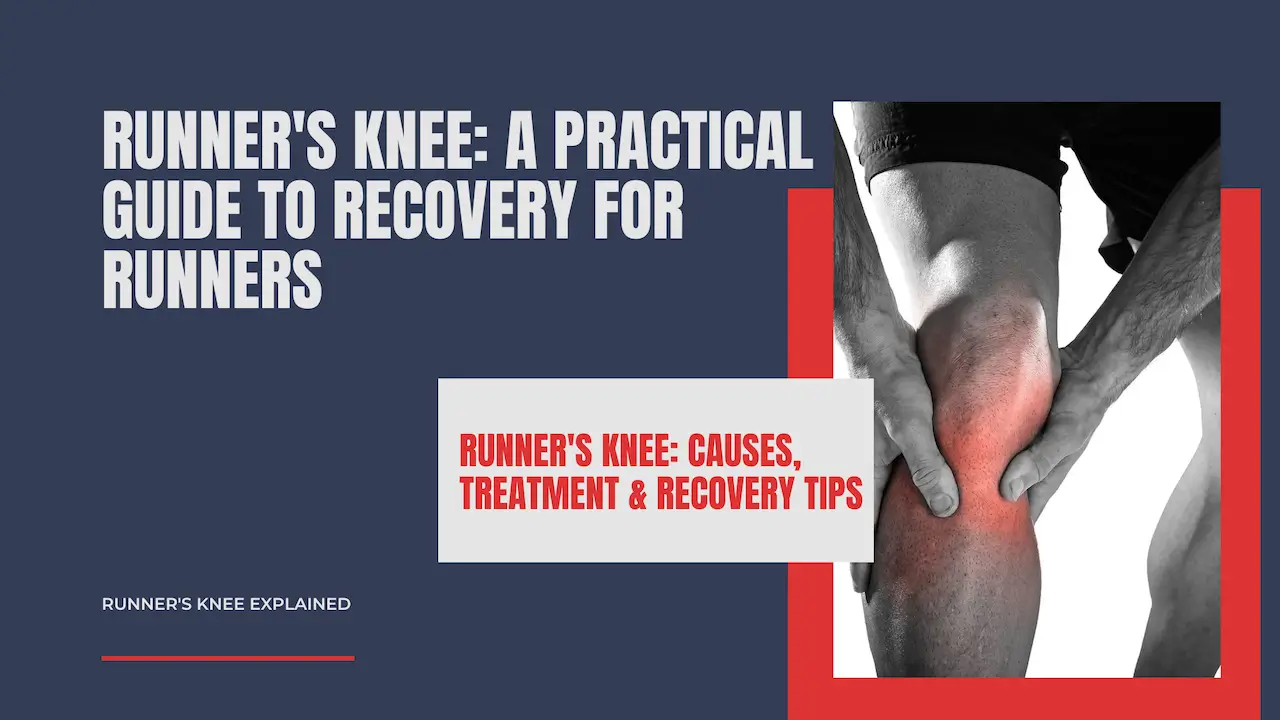
That’s runner’s knee. It’s the most common overuse knee injury in running, accounting for up to 25% of all running-related injuries. And it’s also one of the most mismanaged — because most runners treat the pain, not the problem.
This article covers what’s actually happening in your knee, why your body broke down there specifically, and what a real recovery protocol looks like — backed by clinical research, not generic advice.
- What is runner’s knee?
- Runner’s knee symptoms: how to recognize it
- Causes of runner’s knee: why runners are most at risk
- Runner’s knee treatment exercises
- Hip-focused exercises — the priority
- Quadriceps and VMO exercises
- Short foot exercise — an evidence-based add-on
- Isometric exercises and proprioceptive training
- Runner’s knee treatment methods
- Runner’s knee recovery: timeline and return to running
- How to avoid runner’s knee: prevention for runners
- The bottom line
- Medical disclaimer
What is runner’s knee?
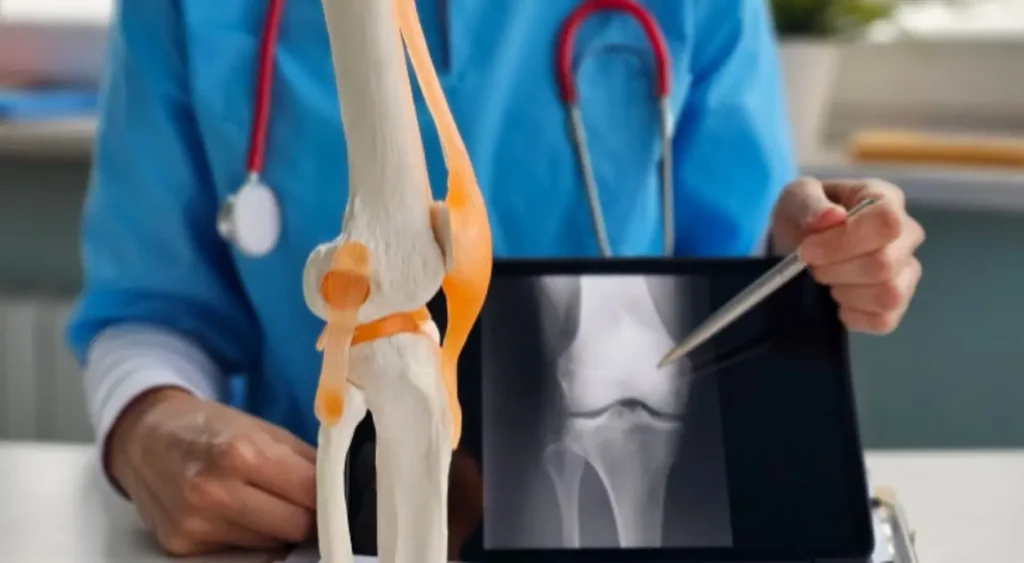
The medical term is patellofemoral pain syndrome, abbreviated PFPS. The pain originates in the patellofemoral joint — where the kneecap (patella) sits against and slides along a groove in the thigh bone (femur). Under normal mechanics, the kneecap tracks smoothly through that groove with every bend and extension of the knee. Under abnormal mechanics, it doesn’t — and that’s where the trouble starts.
Think of the kneecap as a train on a rail. The rail is the femoral groove. When everything is aligned, the train glides. When something pulls it off-center — muscle imbalance, poor hip control, altered gait mechanics — it grinds against the sides of the groove. Repeat that across thousands of steps per run, week after week, and you accumulate microdamage to the cartilage and surrounding tissues faster than they can repair themselves.
One thing worth clarifying: PFPS is a diagnosis of exclusion. That means a clinician has to rule out other causes of anterior knee pain before settling on this one. You’ll also see it referred to as chondromalacia patellae (which specifically implies cartilage degeneration), “moviegoer’s knee” (because prolonged sitting with bent knees is a classic aggravator), or simply anterior knee pain. Different labels, same anatomical location, slightly different emphasis on pathology.
What it’s not. IT-band syndrome causes pain on the outer edge of the knee, not behind the kneecap. Patellar tendinopathy sits below the kneecap, at the tendon insertion — not around or behind it. Osteoarthritis presents differently on imaging and typically in an older demographic. These distinctions matter, because the treatment approach differs. If you’re not certain what you’re dealing with, get an ultrasound. It’s fast, accessible, and definitively shows patellar tracking, cartilage status, and tendon integrity.
Runner’s knee symptoms: how to recognize it
The symptom picture is characteristic enough that most sports medicine clinicians form a working diagnosis before any imaging.
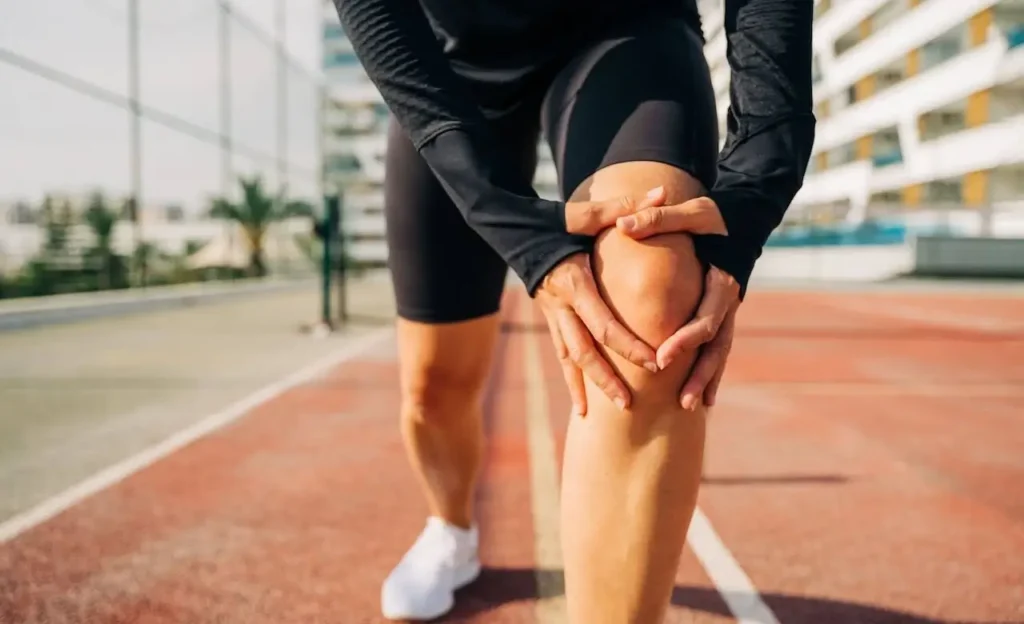
The pain is diffuse, dull, and located around or behind the kneecap. Not sharp, not point-specific the way tendinopathy is. It’s the kind of ache that’s hard to pinpoint with one finger.
It flares with specific loading patterns. Running downhill is the classic trigger — the quadriceps work eccentrically to control descent, generating high compressive load through the patellofemoral joint. Stairs (especially going down), squatting, jumping, and kneeling all aggravate it for the same reason: they require the knee to flex under load, increasing the compressive force on the joint.
The moviegoer’s sign. Prolonged sitting with the knee bent — in a car, at a desk, in a cinema — can trigger or intensify the pain. This is a useful distinguishing feature.
It’s stage-dependent. In early stages, pain appears only toward the end of a long run and resolves quickly with rest. As the condition progresses, it starts earlier in the run, lingers longer afterward, and eventually shows up during ordinary walking and stair use. Some people also notice a grinding or clicking sensation when bending the knee — that’s crepitus, and it suggests some degree of cartilage involvement.
When to stop self-managing and see a doctor:
- No improvement after 4–6 weeks of consistent self-treatment
- Visible swelling around the knee joint
- Pain at rest or pain that wakes you at night
- The knee feels unstable or gives way
- You’re in an active race season and need a clear diagnosis before loading decisions
If you’re a runner mid-season with PFPS symptoms, an ultrasound gives you actual data — fascial thickness, cartilage changes, tendon integrity — that makes every training decision more informed and less of a guess.
Causes of runner’s knee: why runners are most at risk
Running doesn’t cause PFPS. Running exposes the mechanical weaknesses that were already there. Here’s what actually loads the patellofemoral joint beyond its capacity to recover.
Weak hip abductors and external rotators. This is the upstream cause most commonly overlooked when people treat runner’s knee as a “knee problem.” When the hip abductors and external rotators are weak or inhibited, the femur internally rotates and adducts during stance phase — the hip drops inward, the knee follows into valgus, and the patella is pulled laterally out of its groove. Every step becomes a small tracking error. Across 15,000 steps per run, those errors accumulate into tissue damage.
Important nuance here: hip weakness in PFPS is not always the cause — it can also be a consequence of pain inhibiting muscle activation. A systematic review by Rathleff et al. drew a clear line between cross-sectional studies (which show PFPS patients are weaker) and prospective studies (which show hip weakness wasn’t a pre-existing risk factor for onset). The clinical implication: strengthening the hip is still the right intervention, but the causality is more complex than “weak hips = runner’s knee.”
Quadriceps imbalance — VMO vs vastus lateralis. The vastus medialis oblique (VMO) is the teardrop-shaped muscle on the inner lower thigh. When it’s underactivated relative to the vastus lateralis, the lateral pull on the patella dominates, shifting its tracking outward. This is the older, more established mechanism — and it’s still clinically relevant even as the hip-focused model has grown in prominence.
Biomechanical factors specific to running. Excessive foot pronation shifts mechanical load medially through the chain, altering knee alignment. A wider Q-angle (the angle from the hip to the knee to the tibial tuberosity) — more common in women, which partly explains why females develop PFPS at twice the rate of males — increases the lateral vector on the patella. Overstriding (foot landing well ahead of the center of mass) increases braking force and patellofemoral joint compression.
Training errors. Jumping mileage too fast — the same 10% rule that applies to plantar fasciitis applies here. A sudden block of downhill running, track sessions in spikes without adequate adaptation, running through accumulated fatigue without adequate recovery. All of these push cumulative load past the tissue’s repair capacity.
Runner’s knee treatment exercises
Exercise is the primary treatment for PFPS. Not a supplement to treatment — the treatment itself. A 2025 systematic review and meta-analysis (PubMed 39934098) analyzing six randomized controlled trials across 241 patients found that combined hip and knee strengthening (HKS) produced statistically significant improvements in both pain (SMD = −1.29) and functional activity (SMD = 0.99) — and outperformed knee-only protocols on both measures. The logic is straightforward: you have to address the upstream mechanical cause, not just load the symptomatic joint.
Hip-focused exercises — the priority
Clamshells. Lie on your side with knees bent at 90°, feet together, resistance band just above the knees. Keeping the feet together, rotate the top knee upward like a clamshell opening. Control the return. 3 sets of 15–20. This isolates the gluteus medius and external rotators directly.
Side-lying hip abduction. Same position, but straighten the top leg and lift it toward the ceiling — no rotation, no hip flexion, controlled tempo. 3 sets of 15.
Lateral band walks. Resistance band around the ankles or just above the knees, slight squat position, step sideways maintaining hip-width stance. 3 sets of 10–12 steps each direction. Actively resists the valgus collapse pattern.
Single-leg glute bridge. Lie on your back, one knee bent, foot flat, the other leg extended. Drive the hips up through the bent leg, hold 2 seconds, lower slowly. 3 sets of 10–12 per side. Targets gluteus maximus and medius under load, mimics stance phase demands better than bilateral bridging.
Quadriceps and VMO exercises
Terminal knee extension (TKE). Anchor a resistance band behind you, loop it around the back of one knee, stand on that leg with slight bend. Extend the knee fully against the band’s resistance, focusing on VMO contraction. Return slowly. 3 sets of 15. This activates VMO without the high compressive patellofemoral load of deep squats.
Straight leg raise. Lying on your back, one knee bent for spine support, the other leg straight. Tighten the quad on the straight leg, then lift to 45°. Hold 2 seconds, lower controlled. 3 sets of 15. One of the safest early-stage quad exercises — essentially zero patellofemoral joint compression.
Wall sit (isometric). Back flat against a wall, knees bent to 60°—not 90°. Hold for 30–45 seconds. 3 sets. The 60° angle matters: it generates quad activation while keeping patellofemoral compression in a manageable range. Avoid during the acute phase.
Avoid deep squats and lunges in the acute phase. They dramatically increase patellofemoral joint compression. Reintroduce them gradually once pain is controlled and hip strength has improved.
Short foot exercise — an evidence-based add-on
A 2024 RCT (Kamel et al., Journal of Orthopaedic Surgery and Research) added short foot exercises to a standard hip-and-knee protocol and found significantly greater pain reduction and functional improvement compared to the combined protocol alone. The technique: without curling your toes, actively shorten your foot by drawing the ball of the foot toward the heel — the arch rises, the intrinsic foot muscles engage. 3 sets of 15, progressing to single-leg standing as strength improves.
Isometric exercises and proprioceptive training
A 2024 study (PMC11015899) specifically on runners with PFPS found that isometric exercises combined with somatosensory training significantly improved pain, proprioception, and balance compared to standard care. Practical application: single-leg balance work on unstable surfaces (foam pad, BOSU) belongs in the mid-to-late rehabilitation phase, once acute pain is controlled. It trains the neuromuscular control that pure strengthening doesn’t fully address.
Runner’s knee treatment methods
Exercise is the foundation. Everything else is an adjunct that helps you get into a position where you can do the exercises effectively.
Relative rest and load modification. Not stopping entirely — adjusting. Cut out the activities that directly provoke pain: downhill running, stairs, squatting. Replace with swimming, pool running, cycling, or elliptical. These maintain cardiovascular fitness and general conditioning without loading the patellofemoral joint at the angles that aggravate it.
Ice. 15–20 minutes applied after activity. Effective for symptom management in the early, more irritable phase. Not a treatment — a tool for keeping pain low enough to engage in rehabilitation.
NSAIDs. Short-term use (ibuprofen, naproxen) can reduce the acute inflammatory component and allow you to engage with rehabilitation exercises. Don’t use them to train through pain — use them to lower the baseline so the rehab work is possible.
Foot orthotics. A systematic review and meta-analysis (PubMed 35721679 / PMC9204664) confirmed that foot orthoses produce meaningful pain reduction in PFPS, particularly in patients with pronated foot posture. Semi-rigid prefabricated insoles with arch support work for most. Custom orthotics are indicated when there’s a significant biomechanical abnormality that off-the-shelf options don’t adequately address.
Patellar taping (McConnell technique). Tape applied to shift the patella medially provides short-term pain relief and allows patients to perform exercises with less discomfort. It’s not correcting the underlying problem — it’s creating a window for rehabilitation. Useful in the early phases.
Gait retraining. A randomized clinical trial (PubMed 28476901) showed that combining gait retraining with exercise and patient education produced better outcomes than education alone in runners with PFPS. Specific targets: increase step rate (cadence) by 5–10%, which reduces patellofemoral joint load and knee valgus stress; correct overstriding by moving foot strike closer to the center of mass.
Physical therapy — multiple modalities. A systematic review (PubMed 36070427) identified six treatments with positive effects at 3 months: exercise therapy, orthotics, taping, manual therapy, acupuncture, and biofeedback. Exercise is the backbone; the others have supporting roles depending on individual presentation.
Surgery. Arthroscopy and lateral retinaculum release are occasionally discussed for PFPS. A five-year follow-up study (PubMed 21357578) found exercise produced outcomes equivalent to surgery, without the risks and recovery time. Surgery is appropriate only in truly refractory cases — when twelve or more months of comprehensive, well-executed conservative treatment have failed to produce meaningful improvement.
Runner’s knee recovery: timeline and return to running
Realistic timelines. When addressed early — within the first few weeks of symptom onset — most runners can return to easy running in four to eight weeks. Chronic PFPS that’s been left untreated or managed poorly can take three to twelve months to resolve. The biggest variable isn’t the severity of the initial pain; it’s how quickly you address the actual mechanical causes rather than just managing symptoms.
A practical four-phase return-to-run framework:
Phase 1 — Resolve baseline pain. No pain with walking, normal daily activities, or stair use. This is the entry criterion for everything that follows. If you’re still limping or hurting on flat ground, you’re not ready for phase 2.
Phase 2 — Pain-free exercise. Complete the hip and quad strengthening protocol without provocation. The exercises should not reproduce your knee pain. If they do, regress to less provocative variations.
Phase 3 — Run/walk intervals. Start with equal work-rest intervals (1 minute running, 1 minute walking). Criterion: no pain during the session, and no increased soreness the following morning. If you pass that, gradually shift the ratio.
Phase 4 — Progressive return to normal training. Reintroduce volume using the 10% rule. Avoid downhill running until you’ve been pain-free at flat-ground training volume for at least two to three weeks. No tempo work or intervals until the structural phase is solid.
Criteria for full clearance:
- Single-leg squat, 20 repetitions — no pain, no excessive knee valgus
- Stair descent — no pain
- 20–30 minutes of easy running — no pain during, none the following morning
- Symmetrical leg strength when tested (within 10–15% side-to-side)
Maintenance after recovery. The hip strengthening work that got you through rehabilitation needs to stay in your program — not as rehab, but as training. Two sessions per week is enough to maintain the strength levels that keep the patellofemoral joint tracking correctly. The runners who skip this step are the ones who come back with the same injury six months later.
How to avoid runner’s knee: prevention for runners
Control your mileage progression. The 10% rule applies. But beyond total volume, monitor your downhill running specifically. Descents are the primary patellofemoral loading pattern — accumulate too much, too fast, and the joint doesn’t have time to adapt. Build uphill running capacity first; descents follow.
Strengthen the hip proactively. This is the most effective long-term PFPS prevention strategy for runners. You don’t need to be injured to start. Two hip-focused sessions per week — the same exercises described in the treatment section — maintain the abductor and external rotator strength that keeps the patella tracking correctly. Think of it as maintenance for your car, not repair.
Cadence adjustment. Increasing step rate by 5–10% is one of the most accessible biomechanical interventions available to runners. It reduces stride length, decreases the time the foot spends ahead of the body, and measurably lowers patellofemoral joint load. You don’t need a gait lab — a metronome app and deliberate practice will do it.
Footwear management. Replace shoes every 600–800 km. The midsole degrades before the outsole shows obvious wear. Late in a long run, if you start feeling harder ground contact than usual, your shoes have outlived their functional cushioning life. For runners with significant pronation, pairing appropriate footwear with semi-rigid insoles reduces the mechanical chain stress that contributes to patellar malalignment.
Vary your surfaces. Concrete and asphalt are the hardest surfaces you can train on. Alternating with trail, gravel, or treadmill reduces cumulative impact load. If your training is predominantly urban, compensate with footwear that’s appropriately cushioned for the surface.
Don’t ignore early signals. The runners who develop chronic PFPS are almost universally the ones who noticed the early discomfort — the slight ache on the descent, the stiffness after sitting — and chose to push through it because it wasn’t bad enough to stop them. By the time it stops them, the timeline for recovery is four times longer. Catch it early, address it early. A two-week pullback at the first sign is always better than four months off the road.
The bottom line
Runner’s knee is a mechanical problem. It’s produced by how load is distributed through the patellofemoral joint over time, and it’s resolved by correcting the mechanics that created the problem in the first place.
The core of recovery: hip and knee strengthening — prioritizing the abductors and external rotators — combined with load modification that allows tissue adaptation to keep pace with training demand. That’s it. The research is consistent on this point. There’s no shortcut that replaces it.
A runner who starts addressing the actual cause within the first few weeks gets back to full training in four to eight weeks. One who manages symptoms and keeps running at full load for months is looking at a much longer timeline — and a higher likelihood of recurrence.
If you’re returning to training after runner’s knee and want to build your mileage back without repeating the loading error that triggered it, use the training load calculator at calcrun.net to plan your progression.
Medical disclaimer
This article is written for informational and educational purposes only. It is not a clinical diagnosis, a treatment prescription, or a substitute for individualized medical advice. The information presented here reflects current evidence in sports medicine and rehabilitation but cannot account for your specific anatomy, injury history, training background, or clinical presentation.
If you are experiencing knee pain, do not use this article as a basis for self-diagnosis or as a protocol to follow without professional guidance. Runner’s knee (PFPS) shares symptom overlap with several other conditions — some of which require different management entirely. An accurate diagnosis from a qualified sports medicine physician, orthopedic specialist, or physiotherapist is the necessary starting point for any treatment plan.
The exercises and recovery protocols described in this article are general in nature. Individual tolerance, starting fitness level, and the severity of the condition vary significantly between people. What is appropriate for one runner may be contraindicated for another.
If your symptoms are severe, worsening, or have not responded to conservative self-management within four to six weeks, seek professional evaluation. Do not delay assessment in the presence of joint swelling, instability, pain at rest, or night pain.
The medical sources referenced in this article are cited for transparency and reader access to primary literature. They are not presented as endorsement of any specific treatment approach for your individual case.
Medical sources and references:
- NIH StatPearls — Patellofemoral Syndrome
- NCBI InformedHealth — PFPS overview, updated January 2024
- NCBI InformedHealth — How to relieve front knee pain
- PMC7740062 — A Contemporary Approach to Patellofemoral Pain in Runners
- PMC4560005 — Hip/Core vs Knee Strengthening RCT (Multicenter)
- PubMed 39934098 — Meta-analysis: HKS vs KS in PFPS (2025, 6 RCTs, n=241)
- PMC11015899 — Isometric + somatosensory training in runners with PFPS, 2024
- PubMed 35721679 / PMC9204664 — Foot orthoses for PFPS: systematic review & meta-analysis
- PubMed 36070427 — Six treatments with positive effects at 3 months: systematic review 2022
- PubMed 28476901 — Gait retraining + exercise vs education alone, RCT
- PubMed 21357578 — Arthroscopy vs exercise only, 5-year follow-up