
Take two runners. Same age, same weekly mileage, training for the same half marathon. One improves consistently — every few months a new PR, paces that felt hard six months ago now feel manageable. The other works just as hard, logs just as many kilometres, but the clock barely moves.
A big part of that difference comes down to aerobic engine size. And VO2 max is how we measure it.
This guide covers what VO2 max actually is at the physiological level, what numbers are normal for your age and sex, how to estimate yours without setting foot in a lab, and — most importantly — which training methods move the needle and which ones don’t.
- What is VO2 max?
- What is a good VO2 max? Normal values by age and sex
- Wearable estimates — how accurate are they?
- How to estimate your VO2 max
- Method 1 — Cooper 12-minute test
- Method 2 — Wearable device
- Method 3 — VDOT (race-time method)
- Lab test (gold standard)
- How to improve VO2 max running
- 1. High-intensity interval training — the fastest driver
- 2. Tempo runs
- 3. Aerobic base volume (Zone 2)
- 4. How much can VO2 max actually improve?
- Common questions
- Conclusion
What is VO2 max?
VO2 max is the maximum rate at which your body can take up and use oxygen during intense exercise. The unit is millilitres of oxygen per kilogram of body weight per minute — mL/kg/min.
Think of it as your engine’s displacement. A bigger engine doesn’t guarantee you’ll drive fast, but it sets the ceiling. A runner with a VO2 max of 65 mL/kg/min has access to more aerobic power than a runner at 45 — everything else being equal.
The concept is 100 years old. Physiologists Hill and Lupton first described “maximum oxygen intake” in 1923, arguing that the cardiorespiratory system had an upper limit that couldn’t be exceeded regardless of effort. That turned out to be largely correct, and VO2 max has been the gold standard measure of aerobic fitness ever since.
Values vary enormously. Sedentary adults with cardiovascular disease can sit below 15 mL/kg/min. Elite male endurance athletes — Eliud Kipchoge, Kilian Jornet, cross-country skiers at the top of their sport — regularly exceed 85–90. The highest ever recorded in a human is 97.5 mL/kg/min, in a Norwegian cyclist.
Most recreational runners land somewhere between 35 and 55.
Why it matters beyond race times: VO2 max isn’t just a performance metric. It’s one of the strongest predictors of all-cause mortality we have — independent of age, sex, ethnicity, and existing health conditions. A higher VO2 max means a more robust cardiovascular system, better metabolic health, and lower risk of dying from almost anything that matters. Some cardiologists now argue it should be routinely measured alongside blood pressure and cholesterol.
What is a good VO2 max? Normal values by age and sex
“Good” is always relative to age and sex — both decline naturally with time, and women typically score 10–15% lower than men at the same fitness level, primarily due to differences in blood volume, haemoglobin concentration, and lean body mass.
Here’s a practical reference table. Values are in mL/kg/min:
| Age | Men — average | Men — good | Women — average | Women — good |
|---|---|---|---|---|
| 20–29 | 44–51 | 52–60 | 38–44 | 45–52 |
| 30–39 | 42–49 | 50–57 | 36–42 | 43–50 |
| 40–49 | 38–45 | 46–53 | 33–39 | 40–47 |
| 50–59 | 35–42 | 43–50 | 30–36 | 37–44 |
| 60–69 | 31–38 | 39–46 | 27–33 | 34–41 |
These aren’t aspirational targets — they’re population norms. If you’re 45 and running 40–50 km a week, you should be well above the “average” column for your age group.
VO2 max declines naturally with age — roughly 1% per year after your mid-20s in sedentary people. Trained endurance athletes lose it much more slowly, roughly 0.5% per year, because they maintain stroke volume and muscle mitochondrial capacity that sedentary people don’t. This is one of the strongest arguments for keeping consistent aerobic training into your 50s, 60s, and beyond.
Wearable estimates — how accurate are they?
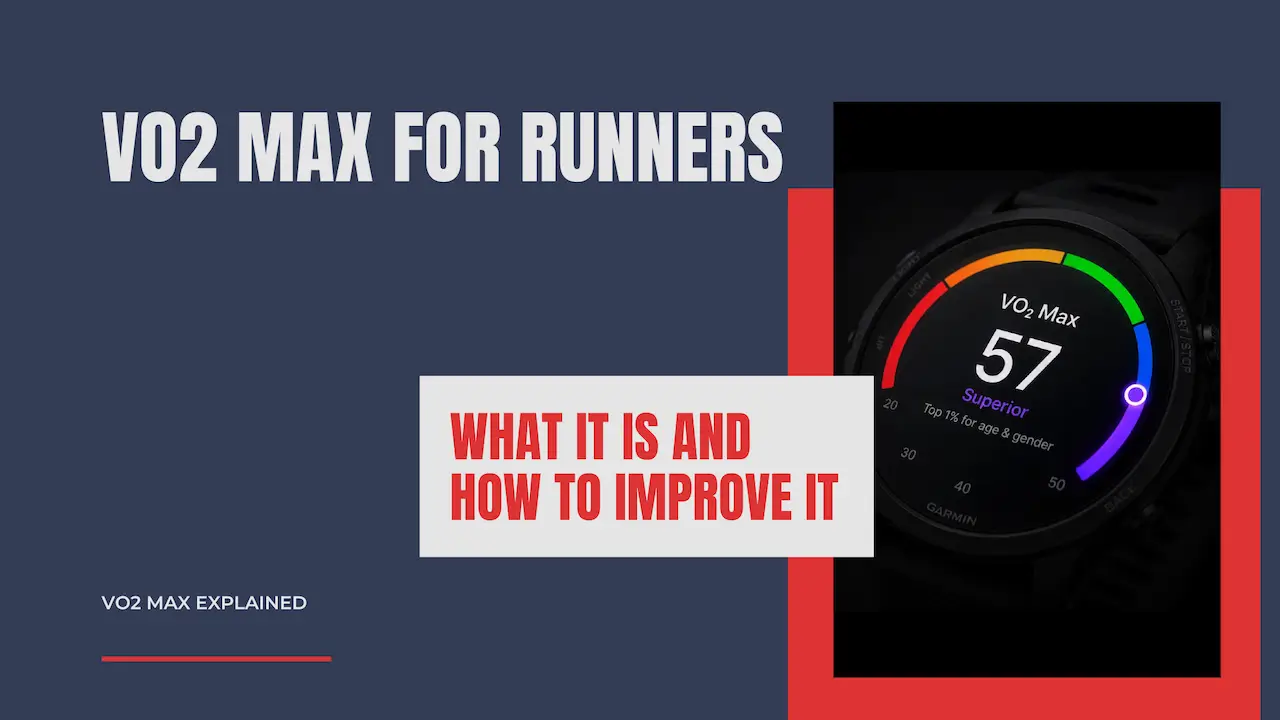
Your Garmin or Apple Watch estimates VO2 max by analysing the relationship between your heart rate and pace during outdoor runs. When your HR is relatively low at a given speed, the algorithm infers high aerobic fitness. When your HR spikes at moderate effort, it estimates lower capacity.
Studies put the error rate at roughly ±5–15% compared to lab measurements. That’s a meaningful gap in absolute terms — a watch might show 52 when your true value is 46 or 58. But for tracking trends, wearable data is genuinely useful. If your Garmin estimate climbs from 43 to 49 over six months of consistent training, that improvement is real, even if the absolute number is off.
Two things that improve wearable accuracy: running outdoors (GPS pace is more reliable than treadmill speed), and letting your heart rate stabilise during longer efforts rather than doing stop-start sessions.
How to estimate your VO2 max
You don’t need a lab to get a useful number. Three practical methods:
Method 1 — Cooper 12-minute test
Run as far as possible in 12 minutes on flat ground. Then use this formula:
VO2 max = (distance in metres − 504.9) / 44.73
Example: you cover 2,800 m. VO2 max = (2800 − 504.9) / 44.73 = 51.3 mL/kg/min
This test was developed by Dr Kenneth Cooper in 1968 and validated extensively since. It’s free, takes 12 minutes, and gives you a repeatable baseline. Do it on a track for accurate distance measurement. Go out at a pace you can genuinely sustain — not an all-out sprint that dies after 4 minutes.
Method 2 — Wearable device
If you run with GPS and heart rate, your watch is already estimating VO2 max in the background. Most Garmin devices display it under “Performance Stats.” Apple Watch shows it in the Health app after a few outdoor walks or runs.
Use it to track direction over time rather than fixating on the absolute number. Set a reminder to check it every four weeks — it should trend upward with consistent training.
Method 3 — VDOT (race-time method)
This is the most practically useful method for runners who actually race. Jack Daniels’ VDOT formula calculates your effective aerobic fitness from a recent race result. A 5K in 22:00 gives a VDOT of ~48; a 10K in 48:00 gives ~47.
VDOT isn’t identical to measured VO2 max — it captures aerobic efficiency alongside raw oxygen uptake — but it correlates closely and, crucially, it also outputs your training paces: easy, tempo, interval, and repetition. That makes it directly actionable.
The fastest way to do this: use the VDOT Calculator — enter your recent race time and it calculates your VDOT, estimated VO2 max, and all your training paces in one step.
Lab test (gold standard)
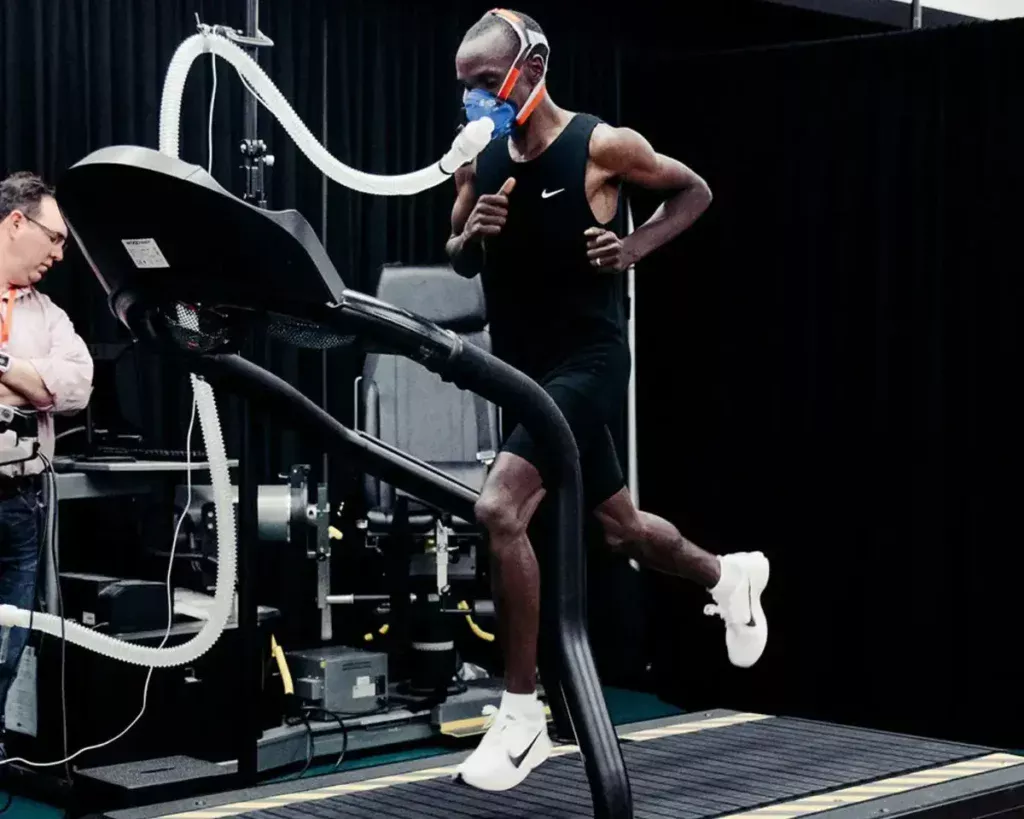
Treadmill or cycle ergometer with a respiratory gas analyser and mask, supervised by a sports physiologist. Accurate, expensive, and not accessible in most cities without a referral or sports medicine clinic. Worth doing if you’re competing seriously or managing a specific cardiovascular condition. For most recreational runners, the methods above are sufficient.
How to improve VO2 max running
VO2 max improves when you force your cardiovascular system to operate at or near its ceiling. Long, comfortable runs don’t do this efficiently — they build the foundation, but they don’t raise the ceiling. You need to push against it. Four training levers, in order of impact:
1. High-intensity interval training — the fastest driver
The most direct way to improve VO2 max is training at VO2 max intensity — roughly 90–95% of maximum heart rate, or the effort you can sustain for about 6–8 minutes flat out.
The protocol with the strongest evidence: 4 × 4 minutes at ~95% of maximum aerobic speed, with 3-minute active recovery between reps. A randomised controlled trial of 48 trained men published in 2023 found this produced a 6.5% improvement in VO2 max over 8 weeks — significantly more than sprint interval protocols and conventional training. The mechanism is straightforward: training at this intensity forces maximum stroke volume and cardiac output, driving the cardiac adaptations that raise VO2 max.
For a runner targeting 5K improvement, this looks like: 4-minute reps at your current 5K pace (or slightly faster), jogging recovery. Start with 3 reps if 4 feels like too much. One session like this per week is enough — two is the ceiling for most runners before recovery suffers.
A more accessible starting point is the Billat 30/30 protocol: 30 seconds at full effort, 30 seconds easy jog, repeated 12–20 times after a warm-up. Less intimidating, still effective, and easier to manage pacing on.
A larger meta-analysis of 53 randomised controlled trials confirmed that HIIT raises VO2 max across healthy adults, obese adults, and trained athletes — and that even short-interval, low-volume HIIT (4 weeks or less) produces clear benefits.
2. Tempo runs
Sustained effort at lactate threshold pace — roughly 85–90% of max HR, an effort you can hold for 20–40 minutes but not much longer — doesn’t raise VO2 max as directly as intervals do, but it improves the percentage of VO2 max you can sustain in a race. That translates directly to faster times at distances from 5K to marathon.
Think of it this way: one runner has a VO2 max of 60 and can race at 85% of it. Another has a VO2 max of 55 and can race at 92% of it. The second runner often wins. Tempo work moves that percentage.
A practical format: 20–35 minutes at a pace you could sustain for an hour race, once a week. Preceded by 10–15 minutes easy warm-up.
3. Aerobic base volume (Zone 2)
Long, easy runs at 60–70% of max heart rate build the infrastructure VO2 max improvements rely on: capillary density in working muscles, cardiac stroke volume, mitochondrial density. Without this foundation, interval training sits on an unstable base.
This is the reasoning behind the 80/20 training model — roughly 80% of total volume at easy effort, 20% hard. The intervals drive VO2 max up; the easy volume consolidates and supports those adaptations.
If you’re running four days a week, three of those days should be genuinely easy (you can hold a conversation without effort). One day is hard intervals or tempo. That’s the structure.
4. How much can VO2 max actually improve?
This is where people often get either too pessimistic or too optimistic.
The common claim is that training can improve VO2 max by only 5–15%. This is based on studies that started with already-fit subjects — there wasn’t much headroom. For sedentary or recreationally active adults starting from a low base, gains of 20–30% are documented in the literature, and outlier cases have shown even more.
What limits individual response is partly genetic. A systematic review of 47 studies found that genetics account for up to 47% of the variation in how much VO2 max responds to training — some people are high responders who gain quickly, others plateau earlier. You won’t know which category you’re in until you’ve trained consistently for 12+ months.
What this means practically: don’t judge your trainability after 6 weeks of intervals. The real picture takes at least two full training cycles (typically 6–12 months) to emerge. And even at the lower end of genetic response, consistent training that includes genuine high-intensity work will improve your VO2 max — and therefore your running times.
Common questions
Yes, directly. Because VO2 max is expressed per kilogram of body weight, losing fat mass while maintaining aerobic fitness raises your relative VO2 max without improving your absolute oxygen uptake at all. A runner who drops 4 kg over a training block might see their wearable estimate climb noticeably — without any change in cardiovascular capacity. This is one reason body composition matters for running performance beyond pure biomechanics.
Up to a point. Adding easy mileage builds aerobic infrastructure and does produce VO2 max gains in untrained runners — but returns diminish quickly once you’re running 40+ km a week. To keep pushing the ceiling, you need sessions that operate at or near VO2 max intensity. Volume supports those sessions; it doesn’t replace them.
Faster than most people expect. After 2–3 weeks of complete rest, measurable declines begin. After 4 weeks of inactivity, VO2 max typically drops 5–10%. The good news: even 1–2 quality sessions per week is enough to maintain most of your aerobic capacity. If you’re injured and can only do easy cross-training (swimming, cycling, elliptical), you’ll retain far more than if you stop entirely.
Genetics influence your ceiling and your response rate, but there are no documented “non-responders” who improve VO2 max by literally zero with appropriate training. Even lower-responder individuals improve with sufficient volume and intensity — they just improve more slowly and plateau at a lower ceiling. Starting unfit and training consistently still produces meaningful gains for everyone.
Conclusion
VO2 max is the most useful single number in endurance running — it captures aerobic capacity, predicts performance across all distances, and gives you something concrete to improve.
Where to start: figure out where you currently stand. Run the Cooper 12-minute test on a track, or plug a recent race result into the VDOT Calculator to get your estimated VO2 max and training paces in one step.
Then build a week that includes genuine hard efforts — one interval session per week at 90–95% of max HR — sitting on a foundation of easy aerobic volume. That’s the structure that moves VO2 max upward over months. Not one heroic workout, but consistent sessions that push against the ceiling until the ceiling rises.
It’s trainable at every age. The only thing that reliably doesn’t work is staying permanently in the comfortable middle.
References:
- Burtscher J, Millet GP, Burtscher M. Celebrating 100 years of VO2max. QJM. 2023. doi.org/10.1093/qjmed/hcad082
- Lundby C et al. Biology of VO2 max: looking under the physiology lamp. Acta Physiol. 2017. PMID: 27888580
- Helgerud J et al. Aerobic high-intensity intervals are superior to improve VO2max compared with sprint intervals. Physiol Rep. 2023. PMC10099854
- Milanović Z et al. Effectiveness of high-intensity interval training on VO2max: Systematic review and meta-analysis. Sports Med. 2015. PMID: 30733142
- Pickering C, Kiely J. Genes to predict VO2max trainability: a systematic review. BMC Genomics. 2017. PMID: 29143670